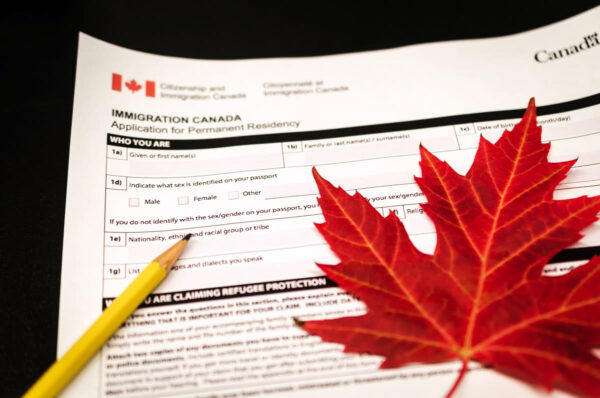
Canada-Ukraine Authorization for Emergency Travel (CUAET) — simplified visas for the Ukrainian citizens suffering in any way from the war with Russia, has truly upended Canada’s immigration regime on Ukraine. The federal Canadian government has already processed more than 150,000 requests for the CUAET visa. This number will only increase, because it is not yet known when the war will end. This number has also grown as a result of the Ukrainian citizens who at the beginning of the war were in Canada and the USA on guest visas.
Let’s recap by saying that the CUAET visa is a multiple-entry visa that is issued for a period of up to ten years or until the expiration of the passport. This visa allows an applicant to stay in Canada for three years, without exiting the country or extending its status (on a normal TRV one can stay in Canada for six months). In addition, the IRCC also issues a three-year open work permit, financial assistance of $3,000.00 per adult ($1,500.00 per child) and other temporary programs to facilitate integration to a new life in Canada. Provincial governments, in turn, provide other assistance. For example, in Ontario, the provincial government approved social assistance in the amount of $730.00 per month per person for six months.
To apply for the CUAET visa from within Canada, you need to be in the country legally. The CUAET is closed to the Ukrainian Nationals who have overstayed their stay in Canada and became illegal. Even if we consider abhorrent war conditions and Canada’s desire to help Ukraine, the CUAET remains closed to the Ukrainian illegals. This reality only underlines the fact that Canada is tough on the individuals who violate its laws and exceed the term of legal stay in the country.
Overstaying is a violation of sec 41 of the Immigrant and Refugee Protection Act (IRPA).
The individuals who have overstayed and lost their legal status have only one opportunity to restore it — within 90 days after their status expired, submit a special application to restore the status and at the same time submit another application to extend it. That is, one needs to submit two applications: one to restore the status, and the second to prolong it. It is interesting to note that the Federal Government has canceled all processing fees for visas and permits for the Ukrainian citizens who are applying for the CUAET, but Canada continues to charge a $200.00 processing fee for an application to restore the status. This once again underlines how harshly Canada treats those who break its laws. After 90 days, there are no more opportunities to restore the status.
So, what can we recommend to individuals who have overstayed their stay in Canada for more than 90 days? In the current state of affairs, only in isolated and unusual situations can a refugee claim be relevant. From the circumstances surrounding us and by assessing the Canadian immigration policy on Ukraine, it is clear that Canada prefers to give a three-year work permit than grant a refugee status to the Ukrainian applicants. Let’s recall that not all Syrians were given asylum in Canada, but only those who opposed the current President Assad, whose regions were destroyed by war, and those who could prove that in Canada they will be able to become economically self-sufficient. That is, they had nowhere to go in Syria to live in peace, and they either had money or were willing to work in Canada.
A person who overstayed its welcome in Canada may still immigrate to Canada by qualifying for a program based on the humanitarian and compassionate grounds. The process of the humanitarian program for that person is complex, expensive, long, and only 1-3% of all humanitarian cases are approved. To win a humanitarian case, it is necessary to write a whole “book” about the hardships and establishment of the applicant in Canada.
However, there is another option. It turns out that Canadian immigration law provides for situations where the Minister of Immigration may intervene in the case of an illegal immigrant to prevent a (humanitarian) disaster, trauma, crisis, etc., provided that such intervention does not endanger Canada or Canadians, and is accepted by Canadian democracy as an appropriate measure. Section 24(1) of the IRPA says,
A foreign national who, in the opinion of an officer, is inadmissible or does not meet the requirements of this Act becomes a temporary resident if an officer is of the opinion that it is justified in the circumstances and issues a temporary resident permit, which may be cancelled at any time.
The Minister’s intervention is called a temporary resident permit (TRP) or “ministerial permit” and is triggered by a request from an illegal immigrant or inadmissible person.
It is called “ministerial permit” because, – in theory, – only the Minister can decide whether to grant such permit to a person or not. Of course, the Minister does not deal with such cases personally, but ordinary immigration officers do not decide them either. Ministerial permits or TRPs are decided at the level of managers of immigration offices. The lowest position authorized to issue the ministerial permits is a team leader, which means that Canada takes all TRP applications very seriously and considers them at the highest possible level.
The TRP can be characterized as a temporary humanitarian relief, and it requires proving not “hardships and establishment,” but the absence of risks to Canada and the need to remain in Canada. The permit is issued to the persons who are not complying with the IRPA or to the persons who are inadmissible to Canada and are outside its borders. To be granted the TRP status, a “mini-book” type of submission needs to be filed on behalf of the client.
Sec 65 of the IRPR stipulates that depending on a non-compliance with the IRPA, a person who has lived in Canada for 3-5 years on the TRP status has the right to automatically apply for the permanent residence in Canada. Immigration officers cannot arbitrarily reject such application. After living on the ministerial permit for six months, the person gets the right to submit documents for an open work permit. That is, the ministerial permit gives the applicant much more rights than CUAET, guest visa, work or student permit, etc.
Of course, there is a negative side to the TRP program. The Minister may impose various conditions on a TRP applicant, like, prohibition to travel abroad. The TRPs can be cancelled at any time if an immigration officer deems that the applicant no longer faces an original crisis situation or has breached the conditions imposed on him/her.
In complex cases that involve Ukrainian illegals, it is necessary to skillfully combine the TRP program with the CUAET visas, in order to obtain the maximum protection and benefit that the Canadian immigration law provides, especially at the time while the war is still raging in Ukraine. This approach allows for the legalization of the illegals, because through the ministerial permits they can acquire valid status in Canada, and the valid status automatically allows them to apply for the open work permit from within Canada, under the CUAET program. By combining two programs together, illegal applicants obtain even more rights than if they applied only under the TRP program.
In conclusion, important to remember that due to the war in Ukraine, all deportations to Ukraine are now prohibited. Therefore, it is advisable to use this safeguard to one’s advantage in order to successfully legalize oneself. If a person has lost his/her legal status in Canada, there is no better time than now to legalize him/her self. The pandemic and war are two compelling factors on the applicant’s side; they will to help justify the entire application.